

Operating in 60+ locations accross the Lower Mainland, Adam's Apples is committed to providing high quality mental health and wellness programs to youth in our communities.
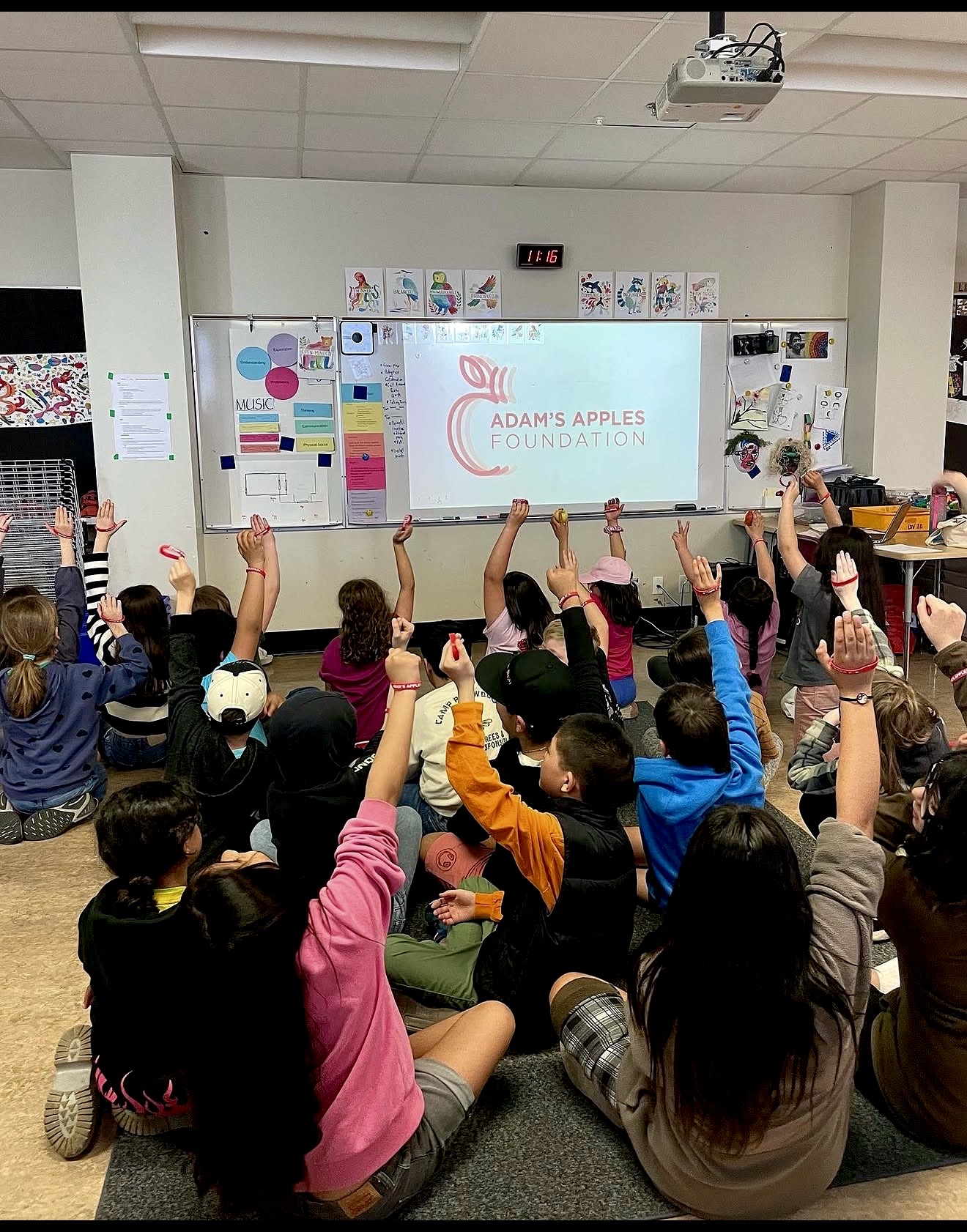
At the “core” of our foundation is the Apple Program. Every week, we deliver apples to more than 60 schools across the Lower Mainland. Students are invited to share a healthy snack and a healthy conversation, a simple moment of face-to-face connection in a world that’s increasingly digital and disconnected.


The Core Connector Initiative is a free mental health and wellbeing program, designed to teach the things most of us never learned in school: how to build healthy friendships, how to navigate hard emotions without drowning in them, how to carry the weight of grades and expectations, and how to step into the unknown of life after high school. We tailor each workshop to your school, so students get what they actually need.
"I have heard many mental health and social media talks at school and I have never been explained to exactly how dopamine affects our brains until today. I found it really interesting that there was an explanation to why I feel anxious or depressed without my phone."
“I enjoyed learning about ways to be present in my own relationships and conversations.”
“I liked how the presentation was really interactive and you showed a lot of different ways to deal with these things. How you really took your time to talk about the stigma around these mental health issues"
“The engagement and knowledge that the instructors possessed. They clearly knew so much about the topic and were very passionate about that. Today they spoke openly and it felt much more engaging.”


The Seedlings Initiative is a Social-Emotional-Learning program developed for elementary school students. The program offers easy to implement 20 minute homeroom exercises on topics under the umbrella of self awareness, social responsibility, and executive functioning.

Self-awareness is guided by introspective practices of self-appreciation, emotion recognition, and managing emotions.
A growth mindset motivates students to take on new challenges and overcome difficulties in their academic and personal life. According to Vygotsky's Zone of Proximal Development hypothesis, students achieve their maximum potential when they face a slightly difficult task independently (Vygotsky, 1980).
Vygotsky's approach emphasises grit: an attitude that supports perseverance in the face of difficult tasks. Teaching students how to practise grit in their daily lives is what builds a growth mindset. Growth mindset lessons aim to help students understand their cognitive abilities as a muscle that can be developed over time (Yeager et al., 2o19). Exposing pupils to a development mindset helps them see their efforts are valuable.
A person’s self-concept, internal feelings about self, determine who they are, what they can accomplish, and who they can become (Burns, 1982).
From the moment they are born, children start to construct their sense of self (Rochat, 1997). This strong inner force acts as a guiding principle through life.
Gratitude is rooted in two key pieces of information: (a) an affirmation of goodness or "good things" in one's life and (b) the realisation that the origins of this goodness are at least largely external to the self (Emmons & Stern, 2013).
Gratitude is becoming increasingly evident as a significant link between many facets of mental well-being, such as lower levels of stress and depression (Wood et al., 2009).
Emotional intelligence is the capacity to assess and manage emotions, recognise triggers, understand cultural norms (Cole et al. 2004; Eisenberg & Spinrad 2004). Emotions may disturb our concentration, memory, learning, relationships, and physical and mental health despite our best attempts (Salovey & Mayer 1990). Identifying and regulating emotions correlates with increased attention, engagement, and positive relationships (Raver, Garner, & Smith-Donald 2007; Brackett, Rivers, & Salovey 2011).
Key factors of emotional intelligence include self-awareness, social awareness, identifying reasons and appropriate expression of emotions, and emotional regulation (Brackett & Rivers, 2014).
Physical and mental well-being is essential to improve behaviour, cognitive functioning, and quality of life, while reducing anxiety and depression (Tromporowski, 2003). Children who are physically active are shown to have lower levels of depression and stress, and higher levels of a positive self-image, life satisfaction and psychological well-being (Rodriguez-Ayllon et al., 2019).
Resilience is a strategy for managing stress, overload, and anxiety symptoms (Schonert-Reich & Le Rose, 2008). Anxiety, sadness, and emotional pain are common reactions to trauma, loss, social exclusion, or family challenges. While educators may not be able to protect children against hardship, they can provide them with the tools that promote a sense of positivity, readiness, and confidence in the face of inevitable challenge.
Competence, confidence, connectedness, character, and caring are all indications of resilience (Lee et al. 2012). These 5 Cs are at the centre when discussing resilience with children and youth.
Making good decisions is a crucial part of daily life. Unfortunately, people of all ages struggle to make long-term, healthy, or ethical decisions. Thus, teaching children the value of excellent decision making is crucial to their future success. Making responsible choices takes significant work and effort in elementary school classrooms (Dotsenko et al., 2020), making early intervention and advice imperative.
Research shows that when given the chance to participate in decision-making, children demonstrate increased engagement with instructors, initiative contributions, and good attitudes (Mancini et al., 1976). Better decision-making abilities help students to develop personal agency, which fosters self-esteem and social connectedness. We empower children to be responsible agents of their own lives by educating them to slow down their decision-making process and consider the consequences.
Goal setting empowers students to control their education by teaching them how to divide objectives down into manageable steps. Studies on self-determination and goal setting have demonstrated that children as young as five and six can develop and attain goals (Palmer, 2003). Goal setting motivates students to create challenging objectives and discuss them with a trusted adult (Hattie, 2007). Goal setting requires feedback and reflective practices where students, classmates, and teachers work collaboratively.
In a classroom setting, teachers may help students set and accomplish objectives by encouraging, guiding, and motivating them. The opportunity to reevaluate goals and discuss their concerns and successes can build students’ capacity for achievement and self-determination (Palmer 2003).
Could we find an alternative way to work on the mobile version. It is too constricted and tight
Empathy training has been demonstrated to promote openness, attentiveness, and positive relationships (McAllister, 2002). Empathy is a key talent for prosocial behaviour: behaviours that foster close connections and strong communities (Silver & Stafford 2017).
Empathy and compassion abilities must be developed throughout adolescence, as this is a critical period for adequate interpersonal development.
Kindness programmes have been shown to improve students' social skills, emotional development, cognitive flexibility, and overall life happiness (Flook et al., 2015; Suldo et al., 2014).
In schools, students' core connections are with their teachers and classmates. Positive connections are more likely to be learned and used in many areas of life if they are modelled and fostered in the classroom. Specifically, evidence shows that children with developmental issues benefit from tight teacher relationships (Baker, 2006).
These positive relationships skills are imperative to social connections and personal well-being.
This feeling of belonging is vital for students as they learn to manage their interpersonal relationships and the larger school community. Research states that people are more likely to adopt behaviours of a group that they feel a part of and respect towards (Ryan, R.M. & Deci, E.L. 2000). Students who feel more linked to and cared for by their parents, teachers, and other adults are more likely to adopt their expected and exemplified behaviours.
Transitions (such as new school environments, unfamiliar teachers, or different friend groups) may disrupt positive learned behaviours, and negatively impact a student’s sense of belonging. While many students attribute their feeling of belonging to their friends, others attribute it to their teacher and the school. (Sanders & Munford) (2016). Students feel more at ease when they are in a pleasant, welcoming, and safe school environment. The goal of these courses is for children to realise their valuable place in the school community.
Community Kindness weeks are opportunities for students to get involved at the school. On the days of the Adam’s Apples apple donations, students may volunteer to help with distributing the apples to different classroom. We encourage students to distribute the apples to grades other than their own.
The aim of this is to have students feel that they are needed and valued, as well as for students to make connections with other students and teachers around the school.


